
Getting a fake Google review feels like a punch to the gut. You know it is not real. Your staff knows it is not real. But the hundreds of potential customers reading it have no way of knowing that — and that is the problem.
Fake reviews are more common than most business owners realise. Whether it is a competitor trying to knock you down, a disgruntled ex-employee venting, or an internet troll with nothing better to do — the effect on your business is very real. A single 1-star fake review can drop your average rating, push away new customers and tank your Google Maps ranking overnight.
The good news? You are not powerless. There is a smart, professional way to handle fake reviews that actually works in your favour — and this guide walks you through every step of it.
How to Spot a Fake Google Review
Before you do anything, you need to be sure the review is actually fake. Not every negative review you disagree with is a fake one — and treating genuine complaints as fake will only make things worse.
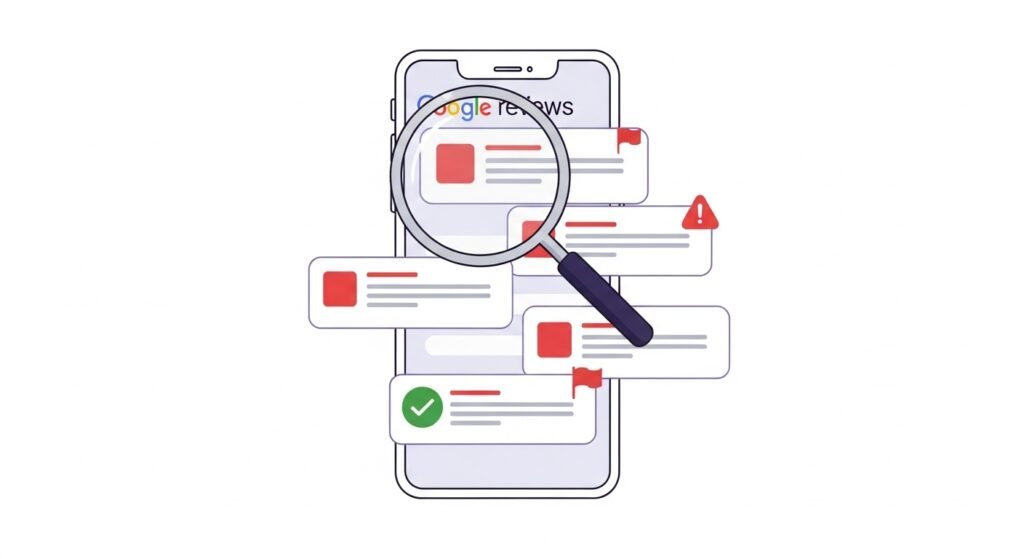
Here are the signs that strongly suggest a review is not genuine:
No history of visiting your business. If you have a restaurant and someone leaves a scathing review about their experience but you have no record of their visit on any given date — that is a red flag. Cross-check your bookings, receipts and staff memory.
A brand new account with no other reviews. Check the reviewer’s Google profile. If the account was created recently, has no profile photo, no other reviews and no local activity — it is almost certainly a fake account created specifically to harm your business.
Suspiciously vague details. Genuine negative reviews usually mention specific details — the name of a staff member, what they ordered, what exactly went wrong. Fake reviews tend to be generic — “terrible service”, “horrible place”, “never going back” — with no specifics because the reviewer was never actually there.
Timing that matches a competitor’s activity. If you notice a cluster of negative reviews appearing shortly after a competitor opened nearby or after a business dispute — that pattern is worth noting.
Multiple reviews posted on the same day. If your business suddenly receives five 1-star reviews in one afternoon from accounts that have never reviewed anything else, something is clearly off.
What Not to Do First
Before we get into what you should do, it is worth talking about the instinctive reactions that will make things worse.
Do not respond with accusations. Publicly calling someone a liar or accusing them of being a competitor feels satisfying for about thirty seconds. Then you realise that every future customer who reads that exchange will see you as the aggressive one — regardless of who is right.
Do not threaten legal action in your reply. Even if you have grounds to pursue it, threatening legal action in a public reply makes your business look desperate and heavy-handed. Handle that privately.
Do not ignore it and hope it disappears. A fake review with no response looks just as bad as a genuine negative review with no response. Silence signals to readers that you either do not care or cannot defend yourself.
Do not flood your page with fake positive reviews to compensate. This is against Google’s policies, it looks suspicious to savvy customers and if Google catches it — and they often do — the consequences are severe.
Step 1 — Flag the Review to Google
Your first move is to flag the review for removal. Here is exactly how:
- Go to your Google Business Profile
- Find the review you want to flag
- Click the three dots next to the review
- Click Flag as inappropriate
- Select the reason that best fits — spam or fake, off topic, conflict of interest
- Submit
Google will then review your flag. Here is the honest truth about this process — it can take anywhere from a few days to several weeks, and Google does not always remove reviews even when they clearly violate their policies. The system is imperfect. But flagging is always your first step because it creates a formal record of your complaint.
If the review is not removed after flagging, you can escalate by going to the Google Business Profile Help Community and posting your case there. Google employees actively monitor that forum and have the authority to remove reviews that the automated system missed.
Step 2 — Respond Publicly and Professionally
While you wait for Google to review your flag, you must respond to the review publicly. This is the most important step of the entire process and here is why.
Your response is not really for the fake reviewer — they know what they did. Your response is for every single potential customer who will read that review over the next months and years. How you handle it tells them everything about your character as a business owner.
Here is a formula that works every time:
Acknowledge → State the facts calmly → Invite contact
A response like this works beautifully:
“Thank you for your feedback. We take all reviews seriously and have thoroughly checked our records for any visit matching your description — unfortunately we have no record of your experience with us. We would genuinely welcome the opportunity to speak with you directly and resolve any concern. Please reach out to us at [email] so we can look into this personally.”
Notice what this response does. It does not accuse anyone of lying. It does not get defensive. It states the facts — you have no record of this visit — and it extends an olive branch. To any neutral reader, this response makes your business look professional, thorough and genuinely customer-focused.
If you are struggling to find the right words in the moment, the Review Reply Generator at reviewreplygenerator.com generates professional, calm replies for exactly this kind of situation in seconds. You can choose from a Polite, Professional or Damage Control tone depending on how serious the review is.
Step 3 — Document Everything
If you suspect the fake review is coming from a competitor or a specific individual, start building a paper trail.
Save screenshots of the review with the date and time visible. Note the reviewer’s profile name and any details that might link them to a competitor. If you receive multiple fake reviews around the same time, document the pattern.
This documentation matters if you ever need to escalate — either to Google, to a legal professional, or in extreme cases, to the police if the fake reviews are part of a broader harassment campaign.
Step 4 — Escalate If Necessary
If Google’s standard flagging process fails you, you have further options:
Google Business Profile support. Go to support.google.com/business and open a support case directly. Explain clearly why the review violates Google’s policies and provide any evidence you have gathered.
Legal avenues for serious cases. In cases where fake reviews are part of a deliberate defamation campaign — particularly from competitors — you may have legal recourse. A lawyer specialising in internet defamation can advise you on whether a cease-and-desist letter or legal action is appropriate. This is rarely necessary for a single fake review but becomes worth considering when there is a pattern of coordinated attacks.
Consumer protection bodies in India. If you are an Indian business owner and the fake reviews appear to be part of unfair competitive practices, the Competition Commission of India is the relevant body. Documented evidence of a competitor posting fake reviews about your business could constitute an unfair trade practice.
Step 5 — Build Your Genuine Review Buffer
Here is the long game strategy that most business owners overlook. The best defence against fake reviews is a large volume of genuine positive reviews.
When your business has 200 genuine reviews averaging 4.6 stars, a handful of fake 1-star reviews have far less impact on your overall rating and on customer perception. Potential customers are smart — they can smell coordinated fake reviews when they are set against a backdrop of hundreds of real, detailed, positive experiences.
Make it a regular practice to ask satisfied customers to leave a review. A simple message after a good experience goes a long way:
“We’re so glad you had a great experience with us! If you have a moment, an honest Google review would mean the world to our small team — it really helps other customers find us.”
The businesses that handle fake reviews best are the ones that have invested in building a genuine review base that can absorb the impact.
A Note on Timing — Reply Within 48 Hours
Whatever you do, respond to any suspicious review within 48 hours. The longer a fake review sits unanswered on your profile, the more damage it does. Speed signals professionalism and shows customers that you are actively monitoring your reputation.
Set up Google Business Profile notifications on your phone so you are alerted the moment any new review appears. You should never be the last person to know what someone is saying about your business online.
The Bigger Picture
A fake Google review feels deeply personal and deeply unfair. It is. But the businesses that handle them best are the ones that refuse to let emotion drive their response. They flag it, respond professionally, document everything and get back to the work of delivering real value to real customers.
Every professional response you leave on a difficult review — whether fake or genuine — is a public demonstration of your values. The customers watching are the ones who matter.
Use our free Review Reply Generator at reviewreplygenerator.com to generate a calm, professional reply to any difficult review in seconds — no signup required.
Frequently Asked Questions
Can Google remove fake reviews? Yes — Google can and does remove reviews that violate their policies. However the process is not instant and is not guaranteed. Flagging the review is your first step and escalating through official support channels improves your chances.
How long does it take Google to remove a fake review? It typically takes between 3 and 14 days after flagging. In some cases it can take longer, especially if Google’s automated system does not immediately identify a policy violation. Escalating through the support forum can speed things up.
Can I sue someone for leaving a fake Google review? In some cases, yes. If the fake review constitutes defamation and you can identify the individual responsible, you may have legal grounds to pursue them. Consult a lawyer before taking any legal action.
What if my competitor is posting fake reviews? Document the evidence carefully — screenshots, timing, links between the reviewer accounts and the competitor. Report to Google and consider consulting a lawyer about unfair competition practices.
Should I respond to every fake review? Yes — always respond. Even a brief professional response is better than silence. It shows potential customers that you are attentive and gives you the opportunity to present your side of the story.
Does the number of fake reviews affect my Google Maps ranking? Yes — a sudden influx of negative reviews can temporarily affect your local search ranking. However Google’s algorithm is increasingly sophisticated at detecting coordinated fake review activity and discounting its impact.
What is the best way to respond to a fake review? Stay calm, state the facts without accusation, note that you have no record of the experience described and invite the reviewer to contact you directly. The Review Reply Generator at reviewreplygenerator.com can generate a professionally worded response for you instantly.
Ready to reply to your reviews like a professional? Try the free Review Reply Generator — paste any review and get four expertly crafted replies instantly