
If you have ever wondered why your competitor’s business shows up before yours on Google Maps — even though you have been around longer, have a nicer shopfront and genuinely offer a better service — the answer is almost certainly sitting right there in their reviews section.
Google Maps rankings are not random. They are not purely about who has the most money to spend on ads. And they are definitely not just about how close your business is to the person searching. Reviews — how many you have, what they say, how you respond to them, and how recent they are — play a significant and often underestimated role in determining where your business appears when someone searches for what you offer.
This article breaks down exactly how that works, why it matters, and what practical steps you can take starting today to use reviews as a genuine competitive advantage.
First — How Does Google Maps Actually Rank Businesses?
Google has been fairly transparent about the three core factors it uses to rank businesses in local search results. They are:
Relevance — how well your business listing matches what the person is searching for.
Distance — how close your business is to the searcher or to the location they specified in their search.
Prominence — how well-known and respected your business is, both offline and online.
Reviews sit squarely within that third factor — prominence. And while you cannot do much about your physical location (distance is what it is), prominence is something you can actively build. That is where reviews become one of the most powerful levers available to any local business owner.
The Four Ways Google Reviews Directly Impact Your Maps Ranking
1. Review Volume — How Many You Have Matters
Google interprets a large number of reviews as a signal that your business is active, established and trusted by real customers. A business with 300 reviews signals something very different to Google’s algorithm than a business with 12 reviews — even if both average 4.5 stars.
Think about it from Google’s perspective. Their entire reputation rests on showing users the most relevant and trustworthy results possible. A business with hundreds of reviews has been validated by hundreds of real people. That carries weight.
This does not mean you need to have more reviews than every competitor in your city. But it does mean that if your nearest competitor has 150 reviews and you have 20, that gap is almost certainly contributing to the difference in your rankings.
2. Review Rating — Your Average Star Score
Your overall star rating directly influences your visibility in the Local Pack — the prominent three-business listing that appears at the top of Google Maps results for local searches.
Google wants to recommend businesses that people are likely to have a good experience with. A business averaging 4.7 stars is more likely to satisfy a new customer than one averaging 3.2 stars. So Google ranks the higher-rated business higher.
What is interesting — and what many business owners miss — is that the relationship between your rating and your ranking is not linear. The difference between a 3.8 and a 4.2 can be enormous in terms of ranking. But the difference between a 4.6 and a 4.9 is much smaller. Getting your rating above the 4.0 threshold and keeping it above 4.3 or 4.4 is where the real ranking gains happen.
3. Review Recency — How Recent Your Reviews Are
A business that received 200 reviews but the most recent one was 18 months ago tells Google something different than a business with 200 reviews and a fresh batch received in the last 30 days.
Google values recency because it signals that your business is currently active and currently delivering good experiences. An old cluster of reviews, however glowing, does not tell Google what your business is like today.
This is why generating reviews needs to be an ongoing practice — not a one-time campaign you ran a couple of years ago and then forgot about. Businesses that consistently appear at the top of Google Maps are almost always businesses that are consistently receiving new reviews month after month.
4. Review Responses — Whether You Reply Matters Too
This is the one that surprises most business owners. Google actually factors in whether you respond to your reviews — and how promptly you do it.
When you reply to a review, you are signalling to Google that your business is active and engaged. You are demonstrating that a real person is behind the listing, monitoring it, and caring about customer feedback. Google rewards this engagement because it improves the quality of the information available to searchers.
Beyond the ranking benefit, there is a powerful human element here. According to research from BrightLocal, 88% of consumers say they would use a business that responds to all its reviews. Responding is not just an SEO tactic — it is one of the most effective trust-building actions you can take.
The Local Pack — Why It Matters More Than Anything Else
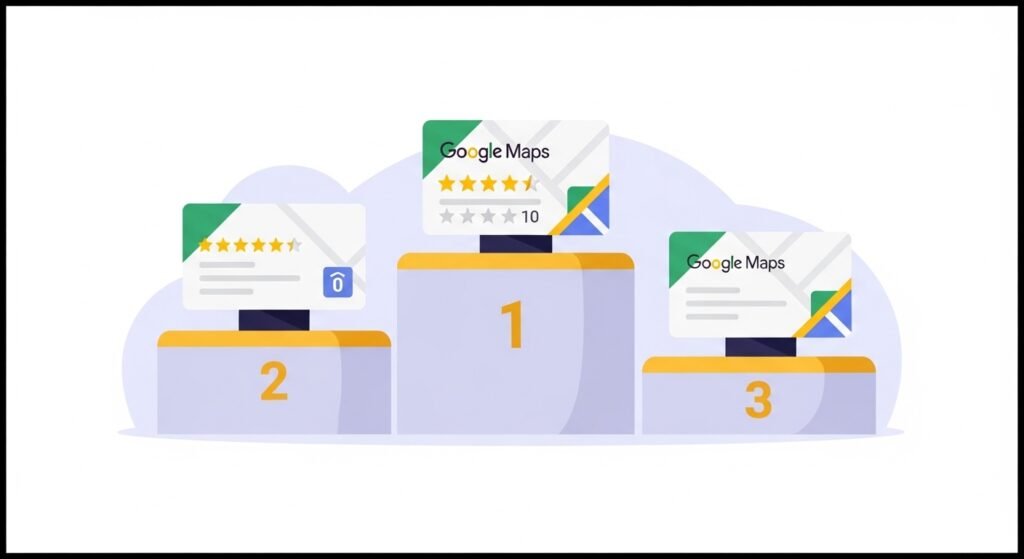
When someone searches “best salon near me” or “dentist in Bandra” or “restaurant open now”, Google typically shows three results at the very top of the page before any organic website results appear. This is called the Local Pack or the Map Pack.
Appearing in those three spots is enormously valuable. Studies consistently show that Local Pack listings receive the majority of clicks for local searches — far more than the organic results below. Being in position one, two or three on Google Maps is the difference between your phone ringing constantly and wondering why your competitors seem so much busier than you.
Reviews are one of the primary ways to get there and stay there. A business with consistent, recent, well-responded reviews will almost always outperform a competitor with more years in business, a fancier website, or a bigger advertising budget when it comes to Google Maps visibility.
Keywords in Reviews — Does What Customers Say Actually Matter?
Yes — and this is something very few business owners know about.
When customers use specific words in their reviews — words that describe your services, your location, your speciality — those keywords help Google understand what your business is about and which searches it should appear for.
For example if you run a dental clinic in Pune and multiple customers mention “root canal”, “teeth whitening” and “best dentist in Pune” in their reviews, Google picks up on those signals. Your business becomes more likely to appear when someone in Pune searches for those specific services.
You cannot control exactly what customers write. But you can influence it by being specific when you ask for reviews. Instead of just saying “please leave us a review”, say “if you enjoyed your experience with our teeth whitening service, we would really appreciate a few words about it on Google.” This naturally prompts customers to mention the specific services you want to rank for.
What Happens When You Stop Getting Reviews
A lot of businesses run a review campaign, get a good number of responses over a few weeks, see their rankings improve and then do nothing further. Six months later they wonder why their position has slipped.
This happens because review recency is a continuous signal. Your competitors who are actively collecting reviews every month are consistently refreshing their prominence signal with Google. Your business, with no new reviews coming in, starts to look static in comparison.
Google is essentially asking itself — is this business still active and still delivering good experiences? Fresh reviews are your answer to that question. Without them, the algorithm gradually starts favouring businesses that are demonstrating ongoing activity.
Negative Reviews and Google Maps Rankings
Here is something worth understanding clearly. A few negative reviews will not destroy your Google Maps ranking — and in some ways, having a handful of less-than-perfect reviews actually makes your business look more credible.
Profiles with nothing but perfect five-star reviews can look suspicious to both Google and to real customers. Everyone knows that no business is universally loved. A mix of reviews, including occasional lower ratings with thoughtful professional responses, can actually build more trust than a perfect score that looks manufactured.
What does hurt your ranking is a sudden spike of negative reviews, a significant drop in your overall average rating, or a pattern of unanswered complaints. These send negative prominence signals to Google and they will impact your visibility.
The key is managing your reviews actively — responding to everything, addressing genuine complaints, flagging fake ones, and continuing to generate fresh positive reviews to maintain a healthy and growing profile.
How to Use Review Replies to Boost Your Ranking Further
Every time you reply to a review, you have an opportunity to naturally include keywords that strengthen your local SEO. This does not mean stuffing your replies with keyword phrases that read unnaturally — that will do more harm than good. But it does mean being thoughtful about how you craft your responses.
For example instead of replying to a positive review with just “Thank you so much!”, consider something like: “Thank you for choosing us for your haircut at our Bandra salon — we are so glad you loved the experience and we look forward to seeing you again soon.”
That reply includes your service type, your location and a warm personal touch. It reads naturally, it satisfies the customer and it gives Google useful contextual information about your business.
Writing these kinds of replies consistently takes time and mental energy — especially when you are managing a busy business. That is exactly what the Review Reply Generator at reviewreplygenerator.com is built for. It generates professional, naturally worded replies in seconds across four different tones — Polite, Professional, Friendly and Damage Control. You get all the ranking and trust benefits of responding to every review without spending hours finding the right words.
A Practical Action Plan Starting Today
If you want to improve your Google Maps position using reviews here is what to do right now:
Start by auditing where you currently stand. Check your current review count, your average rating and when your most recent review was posted. Compare these numbers to the top two or three businesses appearing above you in your category.
Make asking for reviews a standard part of every customer interaction. After every successful transaction, appointment or meal — ask. Not in a pushy way but naturally and genuinely. A simple message or a card with a QR code linking to your Google review page works brilliantly.
Respond to every single review you have received — starting today. If you have unanswered reviews going back months, start working through them. Replying to older reviews still sends a positive engagement signal to Google and still improves the experience for anyone reading your profile.
Handle negative reviews professionally and promptly. A calm, empathetic response to a 1-star review demonstrates more character than ten glowing responses to 5-star ones.
Make this a monthly habit, not a one-off project. Set aside 30 minutes every month to review your Google Business Profile, respond to any new reviews and check in on your ranking position.
The Bottom Line
Google Maps is where millions of customers make decisions about which local business to choose every single day. Your reviews are not just testimonials — they are one of the most direct and actionable ways to influence where you appear in those results.
The businesses winning on Google Maps are not necessarily the oldest, the biggest or the most advertised. They are the ones that have made reviews a consistent part of how they operate — asking for them regularly, responding to all of them professionally and using every reply as an opportunity to strengthen their local presence.
Start today. Respond to every review on your profile. Ask your next happy customer to share their experience. And let the algorithm do the rest.
Try the free Review Reply Generator at reviewreplygenerator.com to generate professional replies for all your Google reviews in seconds — no signup needed.
Frequently Asked Questions
Do Google reviews directly affect Google Maps ranking? Yes — Google explicitly lists prominence as one of its three core local ranking factors, and reviews are a major component of prominence. Review volume, rating, recency and response rate all contribute to your position on Google Maps.
How many Google reviews do I need to rank well? There is no magic number because it depends entirely on your competition. The goal is to have more reviews — and more recent reviews — than the businesses currently ranking above you in your category and location.
Does replying to Google reviews help with SEO? Yes — responding to reviews signals to Google that your business is active and engaged, which is a positive ranking factor. Including natural location and service keywords in your replies can also strengthen your local SEO relevance.
How quickly do new reviews affect my Google Maps ranking? Google typically indexes new reviews fairly quickly — often within 24 to 48 hours. Ranking changes are more gradual and depend on the cumulative effect of multiple reviews over time rather than a single new one.
Can a few bad reviews drop my Google Maps ranking? A small number of negative reviews balanced by a strong overall rating and volume will not significantly harm your ranking. However a sudden influx of negative reviews or a significant drop in your average star rating can negatively impact your local search visibility.
Does the content of reviews affect which searches I appear for? Yes — keywords that customers use naturally in their reviews help Google understand what services and specialities your business offers, which can improve your visibility for related searches.
What is the fastest way to improve my Google Maps ranking? Consistently collecting new genuine reviews, responding to all existing reviews and ensuring your Google Business Profile is fully completed and accurate are the three fastest ways to improve your local search position.
Ready to reply to your reviews like a professional? Try the free Review Reply Generator — paste any review and get four expertly crafted replies instantly